

13 Jun Aided phytostabilisation in a former wood preservation site contaminated with copper (St Médard d’Eyrans, France)
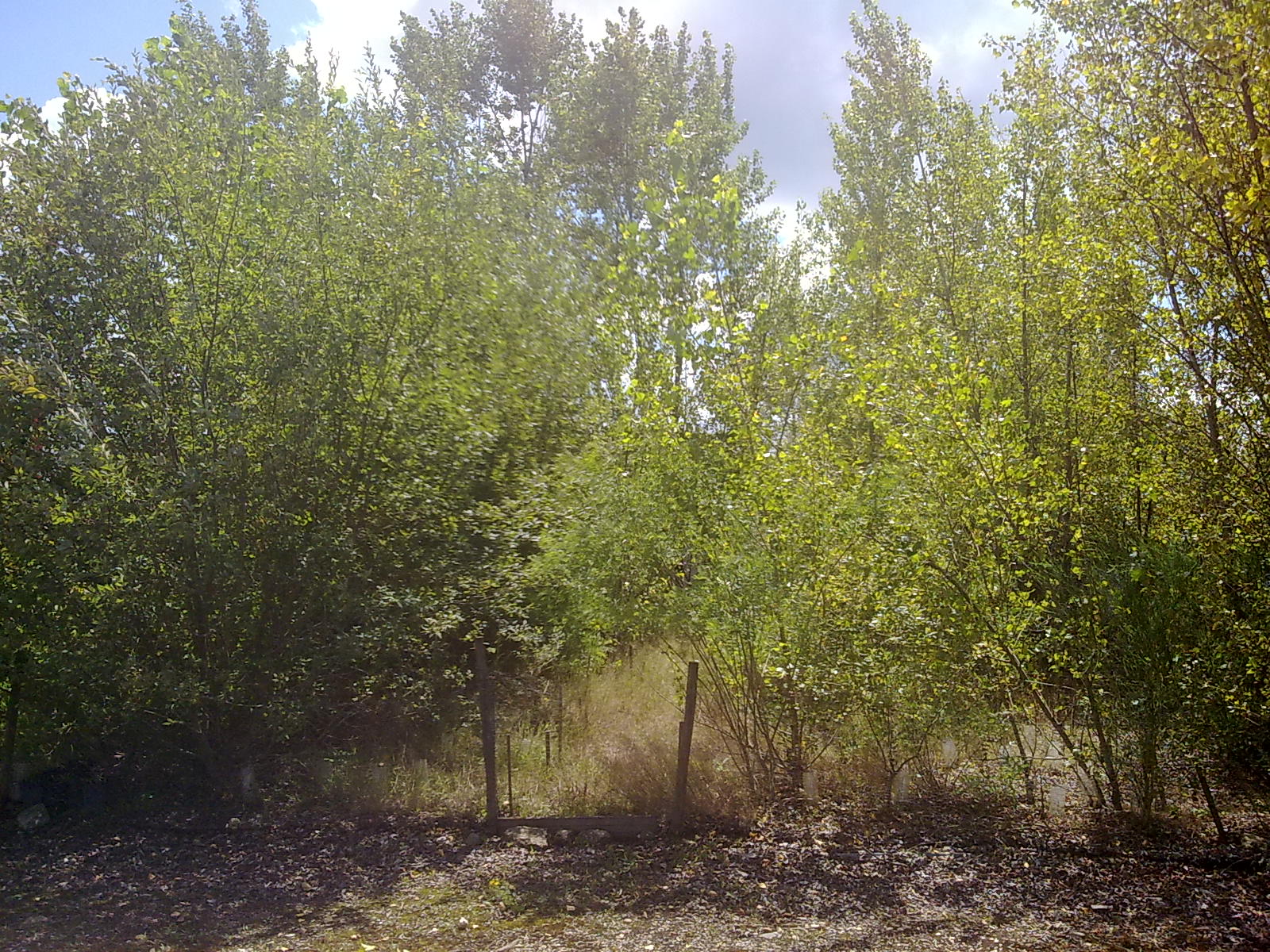
Since December 2016, Michel Mench and its colleagues at INRA are using short-rotation coppice (SRC) species in an aided phytostabilisation experiment in PhytoSUDOE´s S1 site (St Médard d’Eyrans, France). Specifically, the Cu-excluder phenotype of poplar (Populus nigra L.) and willow (Salix caprea L.), both being native populations colonizing some patches on the site, are being tested as (1) to phytostabilize the labile pool of Cu in excess in the contaminated topsoils, (2) to promote the rhizodegradation of organic contaminants such as PAHs, (3) to enhance the structural and functional diversity of plant, animal and microbial communities at this former wood preservation site, and (4) to demonstrate potential wood production for the Bioeconomy (e.g. energy sector, biochar, bioethanol, fiberboard, paper pulp, etc.)
More into detail, two field trials (total soil Cu in the following ranges: PM field trial 674 ± 126 mg/kg, PNM field trial: 845 ± 168 mg/kg) were reorganized, having initially the following four soil treatments (4 replicates): untreated (Unt), a single dressing (5% w/w) of compost made of pine bark and poultry manure (OM,), dolomitic limestone (DL, 0.2% w/w), and compost and dolomitic limestone (OMDL). In December 2016, topsoil (0-10 cm) and subsoil (11-30cm) were sampled according to the standardized PhytoSUDOE protocol to characterize their physico-chemical and biological properties. In February 2017, white clover and alfalfa (cv. Timbale) were sowed on topsoil, after its gentle scraping, to promote soil structure and fertility.
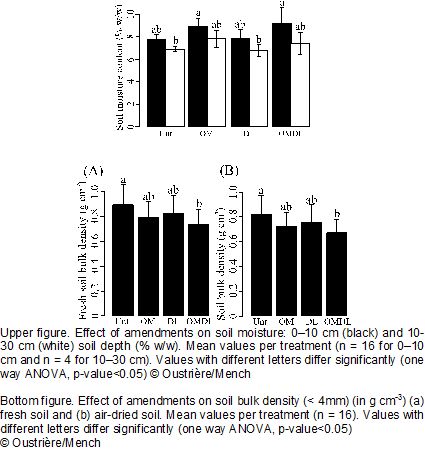
Soil moisture was slightly higher in the topsoil of compost-amended soils albeit differences were only significant as compared to the subsoils of the Unt and DL plots. This would promote both the vegetation cover and the microbial communities in case of water stress. Apart from this, the soil bulk density was lower in the OMDL topsoils as compared to the Unt topsoils. This would reflect a higher soil OM content.
In January 2017, poplar and willow cuttings were collected on site from the formerly established poplar and willow SRC. The purpose was to produce more efficient poplar and willow plants inoculated with plant growth promoting microbes, i.e. mycorrhizal fungi and endophytic bacteria. Cuttings were firstly placed in perlite with a nutrient solution for rooting under a greenhouse. Thereafter, in early March, rooted cuttings were firstly inoculated (50 mL per pot) with a blend of ecto- and endo-mycorrhizal fungi dedicated for tree propagation, plantation and restoration (INOQ Forest; we greatly acknowledged the support of INOQ GmbH, Dr Carolin Schneider, Solhau 2, 29465 Schnega, Germany for this experimental work).
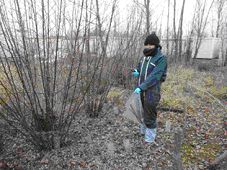
Sampling of poplar and willow cuttings © Mench
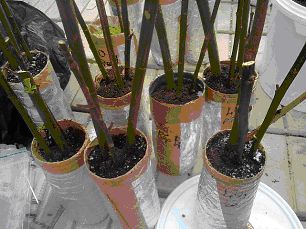 Inoculation of the rooted cuttings with the INOQ Forest© inoculum. © Mench
In early May, the fourth beneficial endophytic bacteria strains provided by the CSIC partner (Dr P. Kidd et al), i.e. SK 1.23, SK 2.3, SK 12.6, and SK 20.18, were cultivated separately in liquid `869´ medium. Suspension of bacteria cells were prepared and 5 mL of each strain were inoculated to each mycorrhizal rooted cutting.
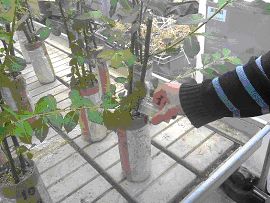 Inoculation of mycorrhizal rooted cuttings with endophytic bacteria suspension. © Mench
In mid-May, poplars and willows inoculated by mycorrhizal fungi and endophytic bacteria were transplanted in all plots of the PNM field trial and available plots of the PM field trial at the S1 site for aided phytostabilisation of Cu-contaminated topsoil. Initial maximum stem length was measured. During the transplantation, roots and rhizosphere soil were again inoculated with the blend of mycorrhizal fungi and the endophytic bacteria. Development of both plant species is monthly monitored.
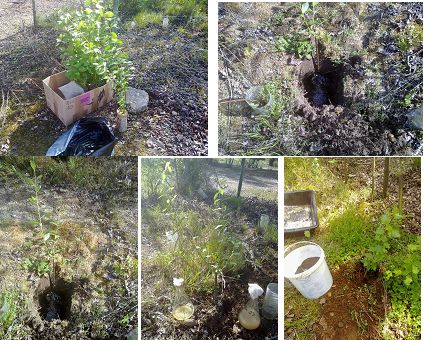
Transplantation of poplars and willows inoculated by mycorrhizal fungi and endophytic bacteria at the S1 site; inoculation of the roots and rhizosphere soil. © Mench