


14 Jun Copper phytoextraction experiment with tobacco and sunflower at PhytoSUDOE´s S1 site
Tobacco and sunflower are being tested at some plots of the S1 site. By applying successive cultures of high yielding crops with a secondary accumulator phenotype, the purpose is to annually strip the phytoavailable fraction of metal(loid)s in excess in the contaminated soils. Tobacco and sunflower have both a potential for phytoextraction a Cd, Zn, and Cu and a sunflower – tobacco crop rotation is used at this former wood preservation site to annually strip a part of phytoavailable soil Cu in excess. Several long-term field plots, with two levels for soil Cu contamination were established prior to PhytoSUDOE with the following soil treatments: unamended (Unt), OMDL (a single dressing (5% w/w) of compost made of pine bark and poultry manure and dolomitic limestone (0.2%)), OM2DL (the first OMDL dressing was followed after 5 years by the incorporation (5% w/w) of greenwaste compost), OM (5%w/w of greenwaste compost), and basic slags (PLC: 1%, P-spiked basic slag; CAR: basic slag Carmeuse). Apart from this, an additional aim was to implement a winter crop, white clover, to improve the soil structure and fertility, and to protect the topsoil from the erosion and leaching.
In early February 2017, tobacco seeds (cv. BAG) were sowed in small plastic pots on an uncontaminated soil. In April tobacco plantlets were individually transplanted in small pots on culture substrate (uncontaminated soil plus a greenwaste compost and a culture substrate made from peat and animal manures) and placed under a greenhouse (soil humidity: 65%).
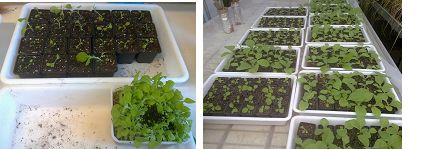
Transplantation of tobacco plantlets in individual pots and cultivation under the greenhouse
In mid April, sunflower seeds (oleic cultivar, SY Valeo, Syngenta) were sowed in the culture substrate (2 seeds/pot). Pots were placed under a greenhouse, with natural day-light, and soil humidity progressively increased from 50 to 65% according to the germination and plant growth. Meanwhile, white clover was developing well during winter and early spring in the field plots having received the greenwaste compost, i.e. OM2DL and OM treatments, and root systems were colonized by rhizobium nodules.
Field plots were manually ploughed in mid-April (0-30 cm). For the first time, after a 10 year cultivation period, earthworms were present in the topsoil and colonizing the OM2DL plots. Shoot samples of white clover, used as winter crop, were harvested before ploughing, notably in the OM2DL plots where it has better developed, to assess their ionome (including the shoot Cu concentration).
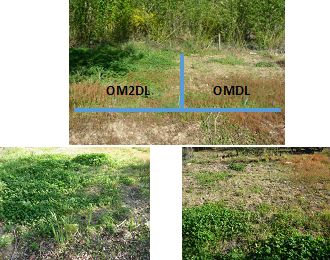
Development of the white clover on the OM2DL (left) and OMDL (right) plots (notice the less plant growth in the OMDL treatment)
In mid-May (17th), sunflower plantlets (development stage: two developed leaves) were transplanted in the field plots (density 21 plants/plot, 105 000 plants/ha). Thereafter in May (22th), tobacco plants (development stage: 4-5 large leaves) were also transplanted in the field plots.
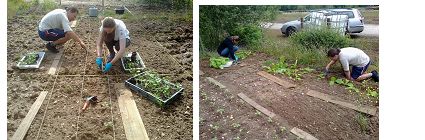
Transplantation of sunflower (left) and tobacco (right) plantlets at the S1 site.
Development of both plant species is weekly monitored and harvest will occur in next September. Shoot dry weight yield and shoot ionome will be determined to compute the shoot Cu removal.
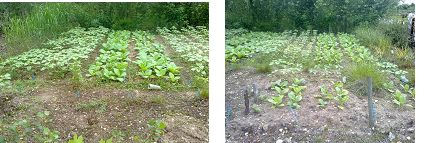
Tobacco and sunflower cultures on the OM2DL (left) and OMDL (right) plots in early June 2017.