


19 Oct PHYTOTECHNOLOGIES REDUCE TOXICITY OF COPPER-POLLUTED SOILS
In a recently-published paper, Quintela-Sabaris et al. (2017) reported the results of a study using metal-contaminated soils from ten European phytomanaged field trials, and which included two of the PhytoSUDOE field sites (Touro, Spain and Saint-Médard d’Eyrans, France; S8 and S1, respectively). Lettuce plants were used to assess the phytotoxicity of the soils after the application of various phytomanagement options: (aided) phytoextraction, in-situ immobilisation, (aided) phytostabilisation…
Analyses focused on three parameters: soluble metal concentrations in the soil solution, shoot metal concentrations and shoot biomass of lettuce plants. In the case of Touro and Saint-Médard field sites, implementation of phytomanagement options reduced soluble and shoot concentrations of copper (only in Touro site) and provoked an increase in shoot biomass (for both sites).
At both sites phytostabilisation and phytoextraction options were implemented, allowing the comparison between these techniques. Considering shoot biomass of lettuce, best results for both sites were obtained by compost amendment followed by phytoextraction.
Overall, the results showed the positive outcomes of the implementation of phytomanagement for the recovery of copper-contaminated soils. Field trials are continuing to demonstrate the long-term effects of phytomanagement on soil processes and functions underlying ecosystem services.

Figure 1: Lettuce plants cultivated on Touro soils. From left to right: CON (control garden soil), UNT (untreated soil), UNT+OM (compost-amended soil), PS (phytostabilisation) and PE (phytoextraction))
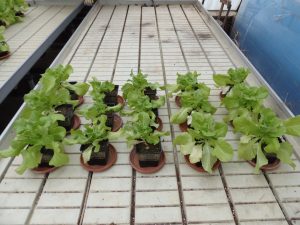
Figure 2: Lettuce plants cultivated on Saint-Médard soils. From left to right: CON, UNT, PS, PE1 (one compost dressing + phytoextraction) and PE2 (two compost dressings + phytoextraction)